
20 Most Asked SEO Interview Questions: How to Answer Them
SEO interviews test your understanding of crawling, indexing, keyword research, website optimization, and performance measurement. Interviewers also want to know how you apply these concepts to real website problems.
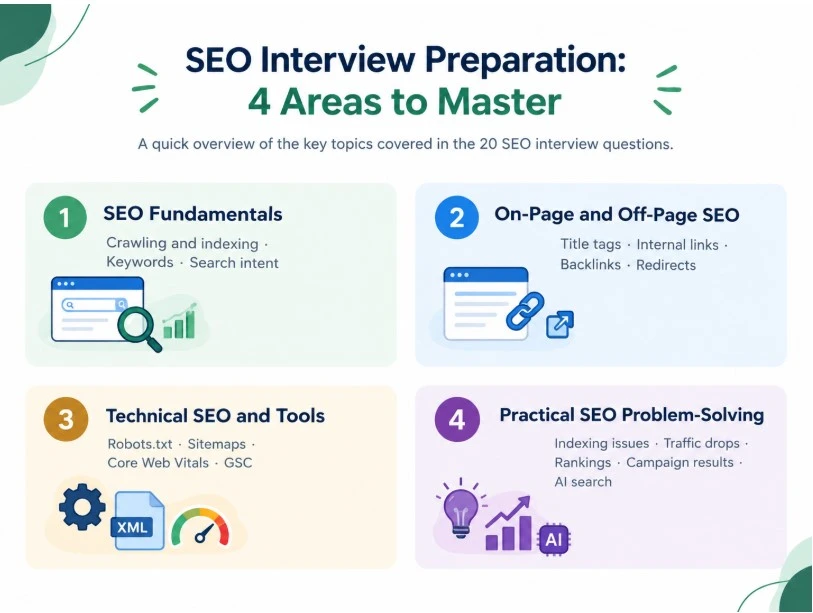
These 20 SEO interview questions and answers cover essential concepts, technical SEO, popular tools, and practical scenarios. Whether you are a fresher or applying for an SEO Analyst role, use the sample answers to prepare and explain your knowledge with confidence.
Basic SEO Interview Questions
1. What is SEO, and why is it important?
Answer: SEO (Search Engine Optimization) is the process of improving a website’s visibility in organic search results. It involves optimizing content, targeting relevant keywords, improving technical performance, and earning quality backlinks.
SEO helps businesses attract relevant visitors, build online visibility, and generate potential leads without paying for every organic click.
2. How do search engines crawl, index, and rank websites?
Answer: Search engines use three main processes to discover and display web pages:
- Crawling: Search engine crawlers discover URLs and access their content.
- Indexing: Google analyzes a page and determines whether it is eligible for inclusion in its index.
- Ranking: Google’s systems select and order relevant results in response to a search query.
Publishing a page does not guarantee indexing or high rankings. The page must be accessible, eligible for indexing, and relevant to users’ searches.
3. What is the difference between on-page SEO, off-page SEO, and technical SEO?
Answer: On-page SEO optimizes page elements such as content, headings, title tags, and internal links. Off-page SEO focuses on external signals, including relevant backlinks and brand reputation. Technical SEO improves crawlability, indexability, site structure, and website performance.
For example, optimizing a blog title is on-page SEO, earning an editorial backlink is off-page SEO, and fixing an indexing issue is technical SEO.
4. What is keyword research, and how do you find the right keywords?
Answer: Keyword research is the process of identifying search terms people use to find information, products, or services. It helps SEO professionals create content that matches search demand and user intent.
To find the right keywords, identify your audience, brainstorm relevant terms, analyze search volume and competition, examine search intent, and prioritize keywords based on relevance and business value. Tools such as Google Keyword Planner, Ahrefs, and Semrush can support this process.
5. What is search intent, and why does it matter in SEO?
Answer: Search intent is the reason behind a user’s search query. The four common types are informational (learning about a topic), navigational (finding a specific website), commercial investigation (comparing options), and transactional (taking an action such as purchasing).
Understanding search intent helps SEO experts create the right type of content. For example, someone searching for SEO interview questions expects a question-and-answer guide rather than a service page.
On-Page and Off-Page SEO Interview Questions
6. What is the difference between a title tag and a meta description?
Answer: A title tag defines a webpage’s title and can influence the clickable headline shown in search results. A meta description summarizes the page and may be used as the search result snippet.
Both should be unique, descriptive, and relevant to the page’s content. Google may generate a different title or snippet based on the search query and page content, so the displayed text is not guaranteed to match the HTML exactly.
7. What are internal links, and how do they help SEO?
Answer: Internal links connect one page of a website to another page on the same website. They help users navigate content and help search engines discover pages and understand their relationships.
An effective internal linking strategy uses relevant links, descriptive anchor text, and a logical site structure. For example, a keyword research article can link to a related guide on search intent.
8. What are backlinks, and how do you earn quality backlinks?
Answer: Backlinks are links from external websites to your website. Relevant, editorially earned backlinks can help search engines discover content, support credibility, and bring referral traffic.
SEO professionals can earn backlinks by publishing original research, creating useful resources, contributing expert insights to relevant publications, and building relationships with industry publishers. Buying links to manipulate rankings or participating in link schemes can violate Google’s spam policies.
9. What is the difference between a 301 redirect and a 404 error?
Answer: A 301 redirect permanently directs users and crawlers from one URL to another. A 404 error indicates that the requested page cannot be found.
Use a 301 redirect when a page has moved permanently and a relevant replacement exists. If a removed page has no suitable replacement, returning a 404 may be appropriate. Avoid redirecting unrelated URLs to the homepage simply to prevent errors.
10. What is keyword cannibalization, and how can you fix it?
Answer: Keyword cannibalization occurs when multiple pages target overlapping search queries or the same search intent in a way that may weaken their performance.
To address it, review affected queries and URLs in Google Search Console, compare page content and intent, and determine whether to differentiate or consolidate overlapping pages. If pages are merged, update internal links and redirect old URLs when appropriate. Multiple pages ranking for similar keywords are not automatically a problem.
Technical SEO and Tools Interview Questions
11. What is the difference between robots.txt and a noindex tag?
Answer: Robots.txt manages crawler access, while a noindex directive tells search engines not to include a page in their index when they can access and process the directive.
Robots.txt is not a reliable way to remove a URL from search results. A crawler must be able to access a page to read its noindex directive, so blocking the page in robots.txt may prevent Google from seeing it.
12. What is an XML sitemap, and why is it important for SEO?
Answer: An XML sitemap lists important website URLs to help search engines discover pages. It is particularly useful for large websites, newly published content, and sites with complex structures.
Website owners can submit sitemaps through Google Search Console to help monitor processing. However, submitting a sitemap does not guarantee that every URL will be crawled, indexed, or ranked.
13. What are Core Web Vitals?
Answer: Core Web Vitals are Google’s metrics for measuring loading performance, responsiveness, and visual stability.
The three metrics are:
- Largest Contentful Paint (LCP): Measures loading performance. A good score is 2.5 seconds or less.
- Interaction to Next Paint (INP): Measures responsiveness. A good score is 200 milliseconds or less.
- Cumulative Layout Shift (CLS): Measures visual stability. A good score is 0.1 or less.
These thresholds are assessed at the 75th percentile of page visits. SEO professionals can use Google PageSpeed Insights to investigate performance issues, although good scores alone do not guarantee higher rankings.
14. How do you use Google Search Console to measure SEO performance?
Answer: Google Search Console is a free tool that helps website owners monitor Google Search performance and investigate indexing issues.
SEO professionals use it to review clicks, impressions, click-through rate (CTR), and average position; identify queries with growth opportunities; inspect URL indexing status; and investigate pages that are not indexed.
For example, a page with many impressions but few clicks may need a closer review of its title, snippet, search intent, and ranking position.
15. Which SEO tools have you used, and what do you use them for?
Answer: SEO tools help professionals research keywords, audit websites, analyze competitors, and measure performance. Common examples include:
- Google Search Console: Search performance and indexing.
- Google Analytics 4: Website traffic and conversions.
- Google Keyword Planner: Keyword ideas and advertising-related search estimates.
- Ahrefs and Semrush: Keyword research, backlinks, and competitor analysis.
- Screaming Frog SEO Spider: Technical website crawling.
- PageSpeed Insights: Page performance analysis.
In an interview, explain how you have used a tool rather than simply listing names. If you are a fresher, describe a practice project honestly instead of claiming experience you do not have.
Practical and Scenario-Based SEO Interview Questions
16. What would you do if a webpage was not getting indexed by Google?
Answer: First, inspect the URL in Google Search Console to understand its reported indexing status. Then check robots.txt restrictions, noindex directives, canonical tags, server errors, and internal links. Review the page’s content and ensure Google can access it.
Fix the identified issue, then request indexing when appropriate and monitor the result. Requesting indexing does not guarantee inclusion in Google’s index.
17. How would you investigate a sudden drop in organic traffic?
Answer: Compare performance in Google Search Console and Google Analytics 4 to identify when the decline started and which pages or queries were affected. Check indexing problems, server errors, recent website changes, ranking changes, and shifts in search demand.
For example, after a website migration, review redirects, canonical tags, and indexing before blaming a Google algorithm update. Base corrective action on verified evidence rather than assumptions.
18. How would you improve a webpage that ranks on page two of Google?
Answer: Review the target keyword’s search intent, competing pages, content quality, and technical health. Improve missing or outdated information, refine relevant on-page elements, strengthen internal links, and resolve any indexing or usability issues.
Use Google Search Console to monitor impressions, clicks, CTR, and ranking changes after making improvements. Focus on making the page more useful and relevant rather than repeating the target keyword.
19. How would you measure the success of an SEO campaign?
Answer: Measure SEO campaign success using metrics that align with the business objective. These can include organic clicks, impressions, keyword visibility, organic sessions, conversions, qualified leads, and revenue.
For example, a B2B SEO campaign may be successful if it generates more qualified leads from organic search, even if every target keyword does not reach the first position. Establish a baseline and evaluate results over time.
20. How would you optimize a website for AI-powered search experiences?
Answer: AI search optimization involves creating helpful, accurate, accessible, and well-structured content that search systems can understand. It builds on established SEO practices and is often discussed through Answer Engine Optimization (AEO) and Generative Engine Optimization (GEO).
To improve AI search readiness, answer questions directly, provide original information and credible evidence, use clear headings, maintain accessible pages, and strengthen relevant internal links. Monitor available AI search mentions or citations alongside traditional SEO metrics, but do not assume that any technique guarantees AI visibility.
How to Prepare for an SEO Interview as a Fresher
Preparing for an SEO interview becomes easier when you combine conceptual knowledge with practical experience. You do not need to know every advanced SEO technique, but you should be able to explain the fundamentals and demonstrate how you approach common problems.
- Learn SEO fundamentals: Understand crawling, indexing, keyword research, search intent, and technical SEO.
- Practise with SEO tools: Explore Google Search Console, Google Analytics 4, and PageSpeed Insights.
- Complete a practical project: Audit a website and document issues involving content, links, and indexing.
- Prepare examples: Be ready to explain how you identified a problem and what you would do to solve it.
- Practise speaking: Explain answers in your own words instead of memorizing them.
Conclusion
SEO interviews test your understanding of search engines, website optimization, SEO tools, and problem-solving. Prepare these 20 SEO interview questions, practise using real examples, and learn to explain your reasoning clearly.
At Cvilians, we encourage learners to build practical skills alongside their SEO knowledge. A strong grasp of the fundamentals and honest examples of your work can help you approach SEO Trainee, SEO Executive, and Junior SEO Analyst interviews with confidence.