
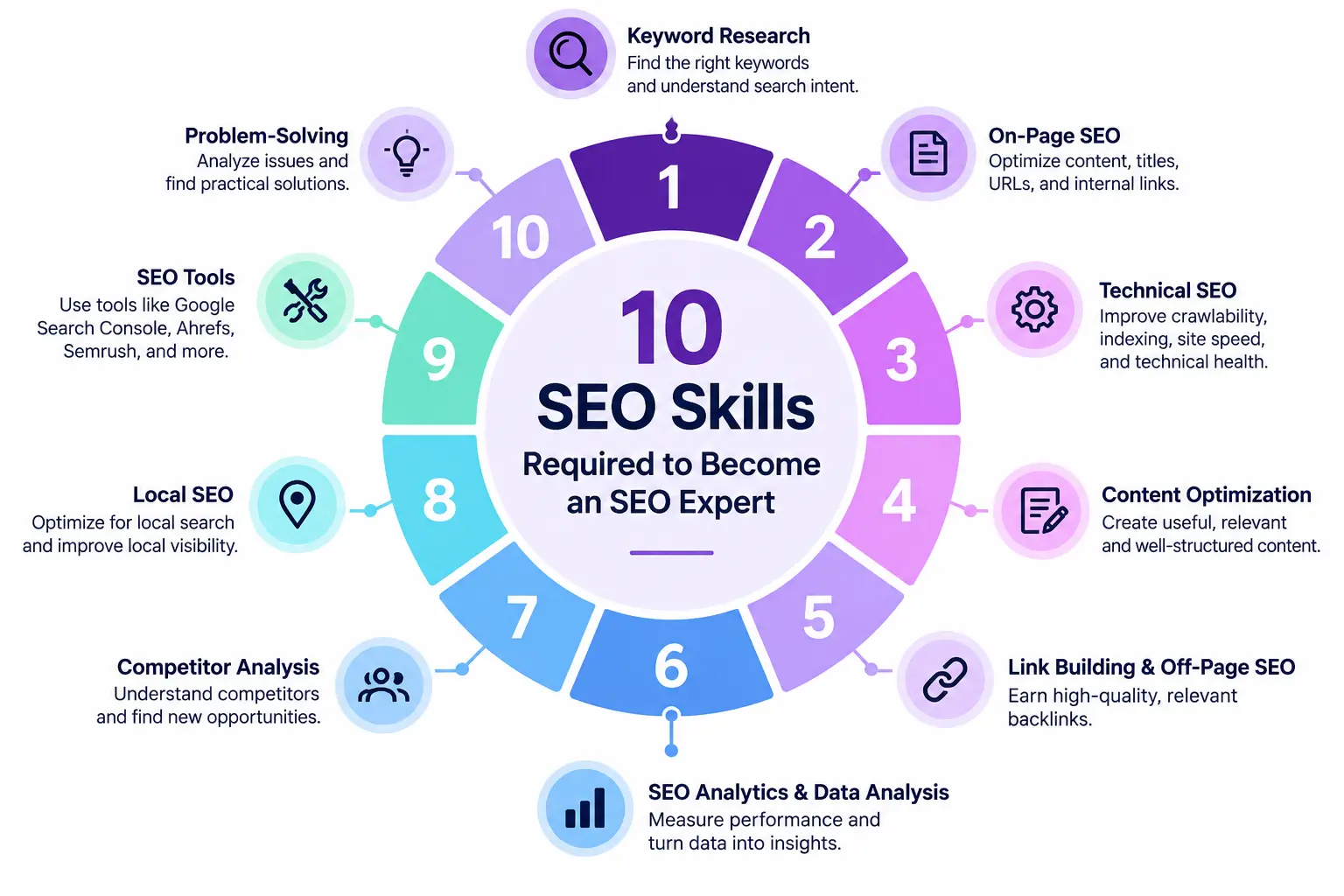
Top 10 SEO Skills Required to Become an SEO Expert
The most important SEO skills include keyword research, on-page SEO, technical SEO, content optimization, link building, analytics, competitor analysis, local SEO, SEO tools, and problem-solving. An SEO expert needs to know how to apply these skills together to improve organic visibility and traffic.
SEO is no longer limited to adding keywords to web pages. Search professionals need to understand how people search, how websites are crawled and indexed, how content satisfies search intent, and how performance data can guide decisions.
If you want to build a career in SEO, developing a combination of technical, analytical, content, and practical skills is more valuable than mastering one SEO technique in isolation.
Why Building SEO Skills Is Necessary in 2026
In 2026, SEO also intersects with AI-powered search experiences, making it increasingly important to create content that is clear, useful, well-structured, and supported by strong website fundamentals.
Search results also include more features, local results, AI-generated experiences, videos, images, and other formats.
This means SEO professionals need broader skills than simply knowing how to optimize title tags or find keywords.
Strong SEO skills can help you:
- Identify valuable search opportunities
- Improve website visibility in organic search
- Diagnose technical and content problems
- Create content that matches search intent
- Measure and improve SEO performance
- Understand what competitors are doing
- Make informed decisions using SEO data
The goal is not to know every SEO concept at once. It is to understand how different skills connect and use them to solve real website problems.
10 SEO Skills Required to Become an SEO Expert
1. Keyword Research
Keyword research is one of the foundational SEO skills. It involves finding the queries people use, understanding their search intent, and identifying which opportunities are relevant to a website.
An SEO professional should be able to evaluate factors such as:
- Search volume
- Keyword difficulty
- Search intent
- Relevance
- Long-tail variations
- SERP competition
For example, a beginner researching “digital marketing” may discover that a more specific query such as “digital marketing course for beginners” better matches a course provider’s audience and intent.
2. On-Page SEO
On-page SEO focuses on improving individual web pages so that they clearly communicate their topic and provide a useful experience for visitors.
This includes optimizing:
- Title tags and headings
- URLs
- Content structure
- Internal links
- Images and alt text
- Meta descriptions
- Keyword placement
The important skill is knowing how to optimize a page without making the content unnatural. A strong SEO professional considers both search engines and the person who will read the page.
3. Technical SEO
Technical SEO helps search engines discover, crawl, understand, and index a website effectively. It also addresses technical factors that can affect user experience and organic performance.
An SEO expert should understand areas such as:
- Robots.txt and XML sitemaps
- Canonical tags
- Redirects and 404 errors
- Website architecture
- Mobile usability
- Page speed
- Core Web Vitals
- Structured data
You do not necessarily need to be a developer to work with technical SEO, but you should be able to identify issues, understand their impact, and communicate practical solutions.
4. Content Optimization
Good SEO content should answer the searcher’s question clearly and provide useful information that matches their intent.
Content optimization involves improving existing or new content based on:
- Search intent
- Topic relevance
- Content gaps
- Readability
- Structure
- Accuracy
- First-hand experience
For example, a page targeting “how to perform an SEO audit” should explain the process clearly instead of simply repeating the phrase “SEO audit” throughout the article.
Clear structure, direct answers, useful context, and trustworthy information can also make content easier for search engines and AI-powered search systems to understand.
5. Link Building and Off-Page SEO
Link building involves earning relevant backlinks from other websites, while off-page SEO covers activities that can strengthen a website’s authority and reputation beyond its own pages.
An SEO professional should understand how to evaluate backlinks based on factors such as:
- Relevance
- Quality of the referring website
- Context
- Authority
- Natural placement
Effective link building is not about collecting the largest possible number of links. The focus should be on earning links that make sense for the website and its audience.
6. SEO Analytics and Data Analysis
SEO analytics helps professionals understand whether their work is producing meaningful results. Knowing how to collect data is useful, but knowing how to interpret it is more important.
An SEO professional should be comfortable analyzing:
- Organic traffic
- Clicks and impressions
- Search queries
- Click-through rate
- Rankings
- Landing-page performance
- Conversions
Tools such as Google Search Console and Google Analytics can provide valuable data, but the real skill is turning that data into actionable decisions.
7. Competitor Analysis
Competitor analysis helps SEO professionals understand why competing websites may be performing better and where opportunities exist.
An SEO competitor analysis can examine:
- Keywords competitors rank for
- Content topics and gaps
- Website structure
- Backlink profiles
- Search intent coverage
- SERP performance
For example, if several competitors rank for a topic your website has not covered, that gap may reveal an opportunity for a useful, better-targeted page.
8. SEO Tools
SEO tools make research, monitoring, and analysis more efficient. However, knowing how to use a tool is different from knowing how to perform SEO.
Depending on the task, professionals may use tools for:
| SEO Task | Example Tools |
| Keyword research | Semrush, Ahrefs, Google Keyword Planner |
| Technical audits | Screaming Frog, Semrush |
| Performance analysis | Google Search Console, Google Analytics |
| Backlink analysis | Ahrefs, Semrush |
| Rank tracking | Semrush, Ahrefs |
For example, an SEO professional might use Google Search Console to identify pages losing clicks, Semrush to investigate keyword opportunities, and Screaming Frog to identify technical issues.
The important skill is knowing which tool to use, what data to examine, and how to turn the findings into actionable SEO recommendations.
9. Local SEO
Local SEO is essential for businesses that want to reach customers in specific locations. It focuses on improving visibility for searches with local intent.
Key areas include:
- Google Business Profile
- Local keywords
- Customer reviews
- Local citations
- NAP consistency
- Location-specific pages
- Local search intent
For example, a person searching for “digital marketing institute near me” has a different intent from someone searching for “what is digital marketing.” An SEO professional needs to recognize that difference.
10. Problem-Solving and SEO Auditing
Problem-solving is what turns SEO knowledge into professional expertise. SEO experts need to investigate why a website or page is not performing as expected and determine what should be fixed first.
Common questions include:
- Why is this page not ranking?
- Why is Google not indexing this URL?
- Why did organic traffic decline?
- Why are competitors outranking this page?
- Which technical issues should be prioritized?
SEO auditing brings many other skills together. A good audit does not just identify problems. It helps prioritize issues based on their potential impact and recommends practical next steps.
How Can You Master These SEO Skills in 2026?
You can develop SEO skills through a digital marketing course, self-learning, practical projects, and consistent hands-on practice. The best approach depends on your learning style, experience, and career goals.
Develop SEO Skills Through a Digital Marketing Course
A structured digital marketing course can give beginners a clear learning path instead of requiring them to piece together information from different sources.
A good course should cover SEO fundamentals while giving learners opportunities to practice keyword research, content optimization, technical SEO, analytics, and other skills.
For learners who prefer guidance and structured learning, a project-based approach can make it easier to understand how individual SEO techniques work together in an actual campaign.
Learn SEO Skills Through Self-Learning
Self-learning gives you the flexibility to study at your own pace. You can learn from official documentation, SEO blogs, videos, industry resources, and practical experiments.
However, self-learning can become difficult when you are unsure what to learn first or how to evaluate your own work. A useful approach is to follow a structured learning path while applying each concept to a real website.
Practice SEO on Real Projects
SEO becomes easier to understand when you apply it to an actual website. You can practice by researching keywords, auditing pages, improving content, analyzing competitors, and monitoring performance.
Working on real websites also helps learners understand that SEO rarely involves one isolated fix. A change in content, site structure, or technical setup can affect several parts of a website’s performance.
Even a personal website or small project can help you understand how SEO decisions affect real pages and search visibility.
Keep Learning and Experimenting
SEO keeps evolving, so becoming an expert requires continuous learning. Search behavior, ranking systems, search features, tools, and AI-powered search experiences can change over time.
Keep testing your assumptions, studying performance data, following reliable industry updates, and learning from real SEO projects.
Conclusion
Becoming an SEO expert requires more than learning a list of techniques. You need to combine keyword research, content, technical SEO, analytics, authority building, and problem-solving to make informed decisions.
Whether you develop these skills through self-learning, practical projects, or a structured learning program at CVilians, consistent practice is what turns SEO knowledge into professional expertise. The more you analyze, implement, and learn from real SEO work, the stronger your skills become.