Email Marketing Jobs and Career: What to Expect?
Email marketing jobs involve creating campaigns, managing subscriber lists, automating customer communication, and measuring results. An email marketing career can lead to specialist, CRM, automation, retention, and management roles. For beginners, copywriting, analytics, marketing tools, and practical campaign experience are valuable starting points.
What Does an Email Marketer Do?
An email marketer plans email marketing strategy and manages campaigns to attract customers, nurture leads, encourage purchases, and retain existing customers. The role combines writing, technical execution, audience research, and performance analysis.
Key responsibilities include:
- Campaign orchestration: Writing email copy, creating layouts, and sending newsletters, promotional offers, and product launch announcements.
- Lifecycle automation: Setting up automated workflows, such as welcome emails, abandoned-cart reminders, and re-engagement messages for inactive subscribers.
- Audience segmentation: Grouping subscribers by interests, purchase history, or engagement so that each audience receives relevant messages.
- List health and deliverability: Monitoring bounces, maintaining clean subscriber lists, and following authentication and sending practices that support reliable delivery.
- A/B testing and optimization: Testing subject lines, calls to action (CTAs), and other campaign elements to identify what improves clicks and conversions.
For example, an online store might use a welcome sequence for new subscribers and a post-purchase email to recommend complementary products. The marketer measures results and adjusts the messages based on customer behaviour.
Types of Email Marketing Jobs
Email marketing jobs vary according to experience, technical knowledge, and business goals. Some focus on campaign execution, while others involve automation, customer retention, and strategy.
| Job role | Main responsibilities |
| Email Marketing Intern | Assist with copy, templates, scheduling, and campaign reports. |
| Email Marketing Executive | Create and send campaigns, maintain lists, and monitor performance. |
| Email Marketing Specialist | Manage segmentation, testing, personalization, and campaign optimization. |
| CRM or Marketing Automation Specialist | Build customer journeys and automated workflows across marketing platforms. |
| Email Marketing Manager | Lead strategy, manage campaign performance, coordinate teams, and connect email activity with business goals. |
Entry-level professionals often begin with execution and reporting before taking ownership of campaign planning. With experience, they can specialise in automation, CRM, lifecycle marketing, or customer retention.
Email Marketing Career Paths & Salary in India
An email marketing career can progress from campaign execution to specialist, managerial, and leadership positions. Salary depends on experience, location, industry, platform expertise, and the revenue or customer outcomes a professional manages.
The following figures are indicative planning ranges, not verified national averages. Actual offers can fall outside them, so compare recent job listings and salary reports before making career decisions.
| Experience level | Example job roles | Key focus | Indicative annual salary |
| Entry level (0–2 years) | Executive, Coordinator, Copywriter | Campaign creation, list management, newsletters | ₹3.5–6 lakh |
| Mid-level (3–5 years) | Specialist, Automation Manager | Lifecycle workflows, testing, platform management | ₹6.5–13 lakh |
| Senior (5–8 years) | Retention Manager, Lifecycle Strategist | Customer lifetime value, repeat purchases, churn reduction | ₹12–25 lakh |
| Leadership (8+ years) | Head of Retention, Director of Lifecycle Marketing | Retention strategy, revenue ownership, loyalty programmes | ₹25–50 lakh+ |
These ranges should be treated cautiously, especially at senior levels.
For context, Glassdoor’s India salary data shows a reported average base pay of around ₹20,000 per month, illustrating how entry-level compensation can differ from broader career estimates.
Professionals who can demonstrate measurable improvements in conversions, customer retention, and campaign revenue may be better positioned for advanced roles. However, higher salaries are not guaranteed by experience alone.
Skills Required to Build an Email Marketing Career
Email marketing professionals need a mix of technical knowledge, writing ability, analytical thinking, and attention to detail. The most useful email marketing skills depend on whether the role focuses on campaign execution, automation, or strategy.
Technical skills
- Marketing automation platforms: Learn tools such as Mailchimp, HubSpot, Klaviyo, ActiveCampaign, or Salesforce Marketing Cloud. Understand how to create campaigns, manage subscribers, and build automated journeys.
- Email deliverability: Understand SPF, DKIM, and DMARC, which help authenticate sending domains and protect email delivery. Google’s official email sender guidelines explain relevant authentication and bulk-sending requirements.
- Data analytics: Track click-through rates, conversions, unsubscribes, and revenue attributed to campaigns. Use these metrics to identify what needs improvement.
- Basic HTML and CSS: Learn to troubleshoot email layouts and make templates work across different devices and email clients.
- Data privacy: Understand consent, subscriber preferences, and applicable regulations such as GDPR and CAN-SPAM. Requirements depend on where your audience is located.
- AI-assisted workflows: Use AI tools to brainstorm subject lines, draft variations, and organise campaign ideas. Review generated content for accuracy, brand voice, and relevance before sending.
Professional and soft skills
- Direct-response copywriting: Write clear subject lines, persuasive messages, and CTAs that encourage readers to take the intended action.
- Customer psychology: Understand customer needs and plan messages around their stage in the buying journey.
- Analytical problem-solving: Investigate why a campaign underperformed instead of assuming that low engagement always results from poor copy.
- Attention to detail: Check links, personalisation tags, formatting, audience selection, and unsubscribe options before launching a campaign.
You do not need to master every digital marketing tool before applying for your first email marketing job. Start with campaign creation, copywriting, basic reporting, and one email platform, then build technical depth as your responsibilities grow.
How to Start an Email Marketing Career as a Fresher (Step-by-Step)
Freshers can enter email marketing without years of experience by learning the fundamentals, practising with relevant tools, and building a portfolio that demonstrates their abilities.
Step 1: Master the Fundamentals
Learn how email campaigns support lead generation, customer engagement, sales, and retention. Understand subscriber consent, segmentation, subject lines, CTAs, and campaign metrics before moving to advanced automation.
Step 2: Get Certifications
Complete relevant courses from recognised learning platforms and practise what you learn. A structured digital marketing course can help beginners understand how email marketing fits alongside SEO, paid advertising, content, and analytics.
Step 3: Build a Portfolio
Create sample projects that demonstrate practical skills. For example, prepare a three-email welcome sequence for a fictional online store, including the subject lines, message copy, CTA, audience, and purpose of each email.
Step 4: Gain Practical Experience
Practise using a free or trial email marketing platform where available. You can also create sample campaigns for a student project, personal website, or community organisation, with appropriate permission and consent for any real subscriber list.
Step 5: Apply for Relevant Roles
Search for titles such as Email Marketing Intern, Junior Email Marketer, Email Marketing Executive, and CRM Executive. Tailor your resume to highlight campaign samples, tools, writing ability, and any measurable results from legitimate projects.
Email Marketing Career Growth and Future Opportunities
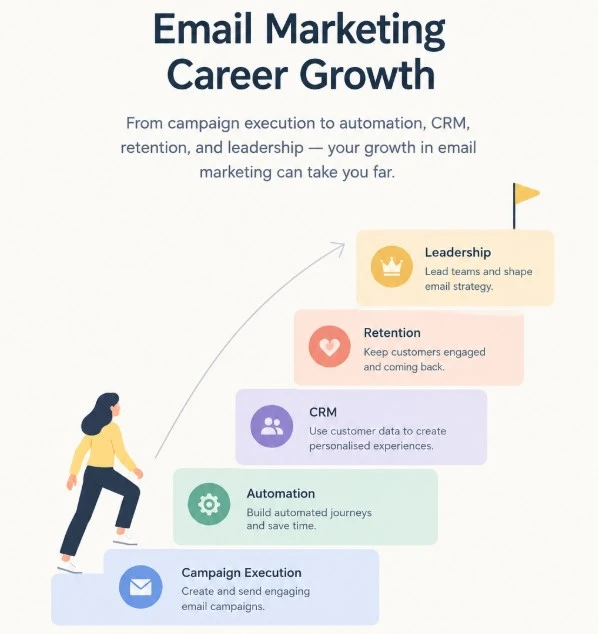
An email marketing career can grow into roles in CRM, marketing automation, lifecycle marketing, retention strategy, and team management.
As you gain experience, focus on audience segmentation, automated campaigns, performance analysis, and customer retention. AI tools like ChatGPT can speed up routine marketing tasks, but strategic thinking and understanding customer behaviour remain important.
To advance, build a portfolio of campaigns, track results, and learn how email marketing supports wider business goals.
Conclusion
An email marketing career can begin with campaign execution and grow into automation, CRM, retention, or leadership. Focus on practical projects, strong writing, analytical skills, and measurable results rather than collecting tools alone.
If you’re planning to build your email marketing career, explore Cvilians to learn how structured digital marketing training can help you develop relevant skills and prepare for career opportunities.