How to Use ChatGPT for Digital Marketing in 2026?
ChatGPT can help digital marketers with research, SEO, content, social media, email, paid advertising, competitor research, and marketing data analysis. It works best as an assistant that speeds up repetitive work, organizes information, generates ideas, and helps interpret data. Marketers still need to provide context, verify important information, add expertise, and make final strategic decisions.
What Can You Use ChatGPT for in Digital Marketing?
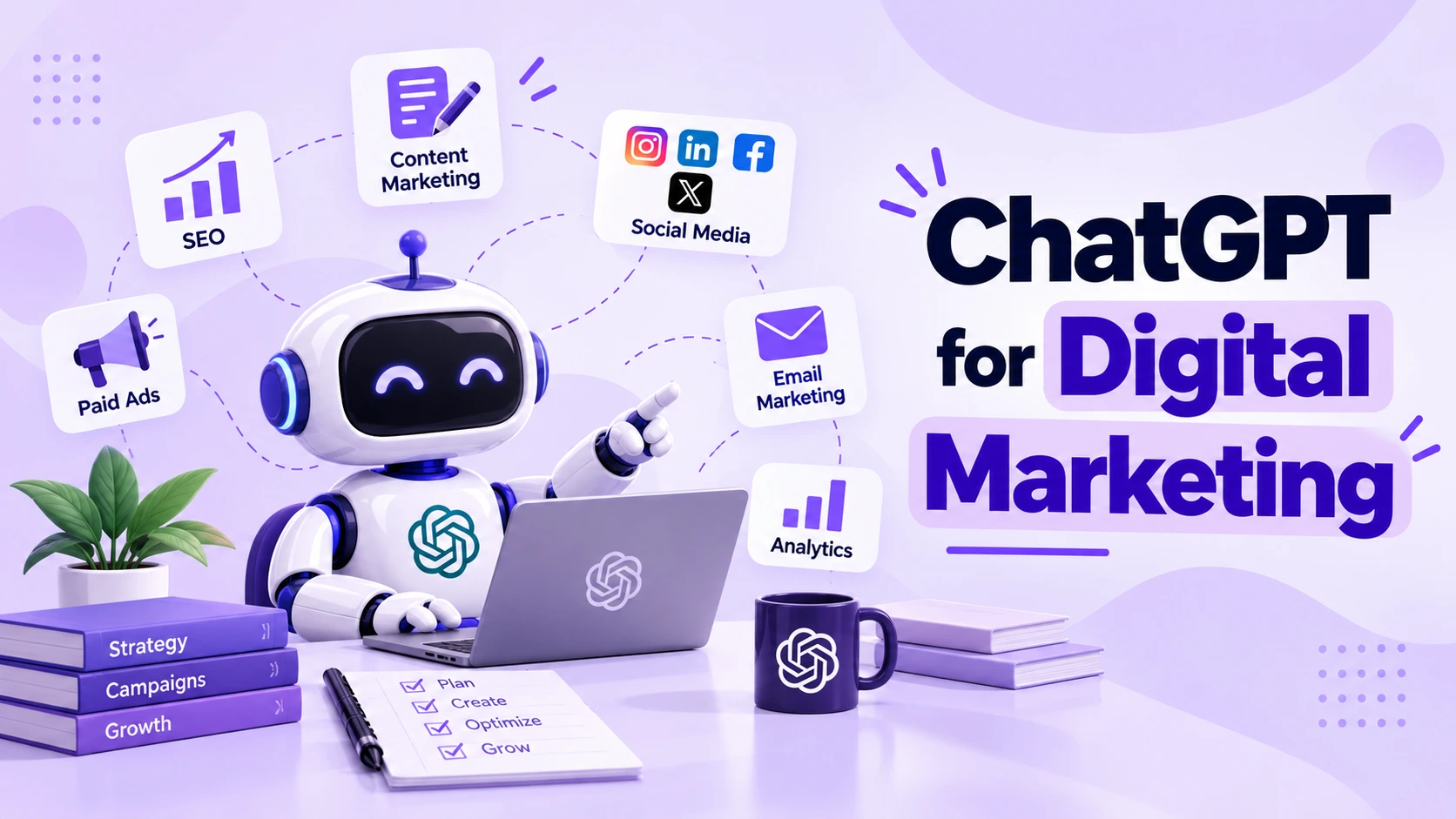
You can use ChatGPT across almost every stage of a digital marketing workflow, from campaign planning to performance reporting.
It can help marketers:
- Organize and analyze information
- Generate and refine marketing ideas
- Create content briefs and drafts
- Adapt content for different channels
- Analyze provided marketing data
- Prepare reports and summaries
- Develop testing ideas for campaigns
The quality of the output depends on the information you provide. A detailed ChatGPT prompt with real business context is usually more useful than a broad request such as “Give me marketing ideas.”
The same principle applies when learning digital marketing with AI, where understanding how tools fit into real marketing workflows matters alongside learning individual platforms.
How to Use ChatGPT for SEO?
ChatGPT can support SEO by organizing keyword data, building content briefs, and suggesting on-page improvements. It works best when paired with actual search and website data.
If you’re building your SEO foundation, understanding the broader SEO skills used in digital marketing can also help put these AI-assisted tasks into context.
1. Find and group keywords
Give ChatGPT an existing keyword list and ask it to group terms by topic and search intent. You can also ask it to identify informational, commercial, navigational, and transactional queries.
For example, an SEO team can provide hundreds of keywords and ask ChatGPT to create topic clusters. Search volume, competition, and SERP relevance should then be validated with SEO tools.
2. Create content briefs
ChatGPT can turn keyword research into a practical content brief. Ask for search intent, primary topic, supporting questions, potential headings, entities to cover, and information readers expect.
3. Improve on-page SEO
Use ChatGPT to review title tags, meta descriptions, headings, internal linking opportunities, content gaps, and keyword placement.
Provide the page copy, target query, audience, and business goal rather than simply asking it to “optimize this page.”
How to Use ChatGPT for Content Marketing?
ChatGPT can speed up content marketing by helping marketers move from ideas to useful assets while keeping human expertise at the center.
1. Generate content ideas and topic clusters
Give ChatGPT your audience, industry, existing topics, and business goals. Ask it to identify useful themes, supporting articles, customer questions, and gaps in your current plan.
2. Create outlines and first drafts
ChatGPT can create a first outline or draft from a clear brief. Add original examples, customer insights, expert commentary, data, and practical experience during editing.
3. Repurpose existing content
A detailed blog can become LinkedIn posts, email content, short video scripts, FAQs, or social ideas. This helps teams get more value from content they have already researched.
How to Use ChatGPT for Social Media Marketing?
ChatGPT can help social media teams plan, adapt, and test content without making every post from scratch.
1. Create content calendars
Provide your audience, platforms, posting frequency, campaigns, and key dates. ChatGPT can organize these into a weekly or monthly calendar.
2. Write and adapt social posts
Turn one idea into platform-specific versions. A detailed industry insight, for example, can become a LinkedIn post, short caption, and discussion prompt.
3. Generate hooks and content variations
Ask for multiple hooks, opening lines, calls to action, or post angles. Select and refine the versions that match the brand voice.
How to Use ChatGPT for Email Marketing?
ChatGPT can support email marketing by generating ideas, improving copy, and creating variations for different audiences.
1. Generate subject lines and email ideas
Give ChatGPT the email goal, audience, offer, and tone. Ask for several subject line approaches rather than one generic option.
2. Draft and personalize email copy
It can help structure newsletters, welcome emails, follow-ups, and promotional messages. Provide audience segments and relevant customer information to make drafts more specific.
3. Create A/B testing ideas
Ask for variations of subject lines, openings, calls to action, or messaging angles. Actual winners should be determined using campaign performance data.
How to Use ChatGPT for Paid Advertising?
ChatGPT can help paid media teams develop ad messaging and testing ideas, but performance should be evaluated using advertising platform data.
1. Create ad copy variations
Provide the product, audience, offer, platform, and character limits. ChatGPT can generate headline and description variations for testing.
2. Develop audience-specific messaging
Ask it to adapt messaging for customer segments, awareness levels, or pain points. This helps teams explore angles before launching campaigns.
3. Generate A/B testing ideas
Use ChatGPT for test ideas around headlines, offers, calls to action, landing page messaging, and creative concepts.
How to Use ChatGPT for Competitor and Market Research?
ChatGPT can organize research and help identify patterns, but competitor claims and market facts should be checked against reliable sources.
1. Analyze competitor messaging
Provide competitor pages, product descriptions, or research notes and ask ChatGPT to compare positioning, messaging themes, features, and content angles.
2. Organize audience insights
Customer interviews, surveys, reviews, and support questions can be grouped into common pain points, objections, needs, and questions.
3. Identify content and positioning opportunities
Once reliable information is collected, ChatGPT can turn it into content themes or positioning ideas. This is more dependable than asking it to invent market research.
How to Use ChatGPT to Analyze Marketing Data?
ChatGPT can help marketers interpret datasets, identify patterns, compare periods, and turn performance information into clearer reports.
1. Identify trends and patterns
Provide a relevant dataset and ask it to identify increases, declines, unusual changes, and segments needing further investigation.
2. Compare campaign performance
Ask it to compare channels, campaigns, landing pages, or time periods using metrics such as traffic, leads, conversions, or revenue.
3. Create reports and summaries
ChatGPT can turn detailed performance information into a concise team or client summary. Check calculations and source data before sharing it.
How to Write Better ChatGPT Prompts for Digital Marketing
Better prompts produce better marketing outputs. A useful structure is:
Context + Goal + Audience + Data + Constraints + Output format
Instead of “Give me SEO ideas,” provide the website type, target audience, keyword, existing content, business goal, and preferred output.
You can also ask ChatGPT to identify assumptions, separate facts from suggestions, and explain what information is missing.
Useful ChatGPT Prompts for Digital Marketing
For SEO:
Act as an SEO strategist. Analyze the following keyword list and group the keywords by search intent and topic. Identify primary and secondary keywords for each cluster, explain the likely search intent, and suggest a suitable content type for each group. [Paste keywords]
For Content Marketing:
Act as a content strategist. Based on this target audience, business, and topic, suggest 10 content ideas that address real customer questions and different stages of the buyer journey. Include the search intent, content format, and unique angle for each idea. [Add details]
For Social Media Marketing:
Act as a social media strategist. Create a 2-week content plan for [brand/business] targeting [audience]. Include post topics, formats, hooks, captions, and calls to action for each post. Keep the ideas platform-specific and avoid repetitive content.
For Email Marketing:
Act as an email marketing specialist. Create a 5-email sequence for [audience] with the goal of [goal]. For each email, provide a subject line, preview text, key message, call to action, and recommended send timing. Keep the copy clear and natural.
For Paid Advertising:
Act as a paid advertising strategist. Create 10 ad copy variations for [product/service] targeting [audience]. Include headlines, descriptions, key benefit, and call to action. Use different messaging angles and follow these platform requirements: [add requirements].
For Competitor and Market Research:
Act as a market research analyst. Compare these competitors based on their target audience, positioning, products or services, content themes, messaging, and visible differentiators. Separate directly observed information from your interpretation. [Add competitors and sources]
For Analysing Marketing Data:
Act as a marketing data analyst. Analyze this dataset and identify the most important performance changes, trends, outliers, and possible reasons behind them. Present the findings in a table with the metric, change, evidence, and recommended next step. Do not assume causes that the data cannot support. [Upload or paste data]
The more useful context you provide, the easier it is to turn a general AI response into something relevant to your marketing workflow.
What Digital Marketing Tasks ChatGPT Cannot Do?
ChatGPT cannot replace reliable marketing data, first-hand business knowledge, or human strategic judgment. It should not be treated as an automatic source of truth.
Do not rely on it alone to:
- Guarantee search rankings or campaign results
- Replace analytics and advertising platforms
- Verify every factual claim automatically
- Understand customers without sufficient context
- Make final budget or strategy decisions
- Publish important content without human review
The strongest workflow is usually AI assistance + reliable data + human expertise + review.
Conclusion
ChatGPT is useful for digital marketing because it can support connected tasks, from keyword organization and content planning to campaign analysis and reporting. The goal is not to hand marketing decisions to AI.
Use it to reduce repetitive work, explore ideas, structure information, and accelerate workflows. Then add business knowledge, verify important details, and use real performance data to decide what happens next.
This practical approach is also reflected in how Cvilians combines AI-assisted workflows with hands-on digital marketing projects.