What You Learn in an AI-Powered Digital Marketing Course
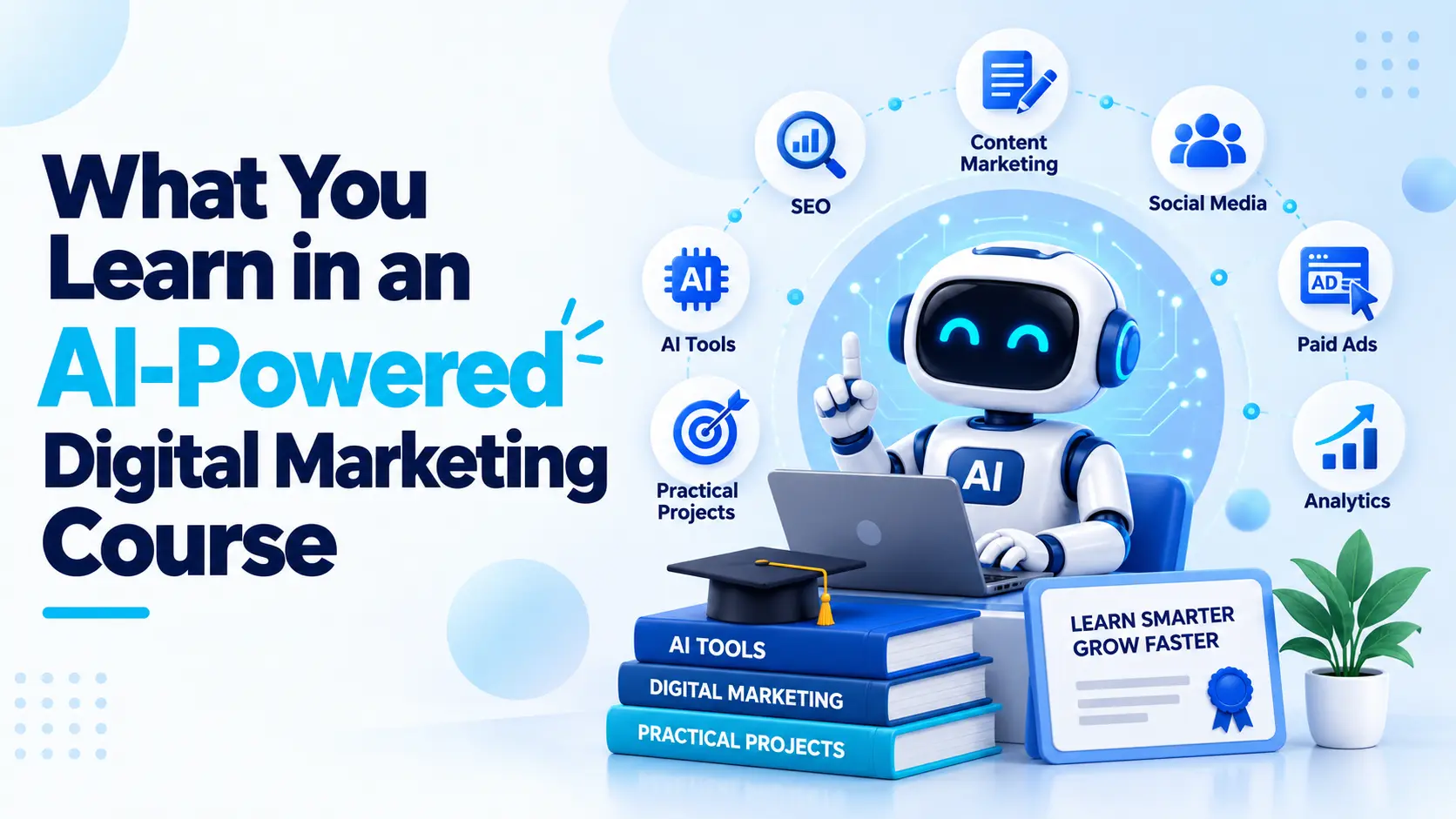
An AI-powered digital marketing course teaches you how to plan, execute, measure, and optimize campaigns across SEO, content marketing, social media, paid advertising, and analytics, while using AI to speed up research and execution through practical projects.
What Is an AI-Powered Digital Marketing Course?
An AI-powered digital marketing course combines core marketing skills with AI-assisted workflows used to research, create, execute, and improve campaigns. You learn both the fundamentals of digital marketing and how AI can make everyday marketing tasks faster and more effective.
Unlike a course focused only on AI tools, a well-rounded program first teaches why a marketing activity matters, then shows where AI can support it. For example, AI can help generate content ideas, analyze data, or create ad variations, but marketers still need to check accuracy, understand the audience, and make strategic decisions.
What You Learn in an AI-Powered Digital Marketing Course?
An AI-powered digital marketing course typically covers the major digital marketing channels while showing how AI can support research, execution, and optimization.
1. Digital Marketing Fundamentals
You first learn how different digital marketing channels work together to attract, engage, and convert an audience. These fundamentals provide the context needed to use AI effectively instead of treating it as a shortcut.
Key areas include:
- Digital marketing channels and their roles
- Target audience and customer research
- Marketing funnels and customer journeys
- Campaign goals, KPIs, and basic strategy
- Competitor and market research
Before creating a campaign, you need to know who you are targeting, what problem you are solving, and which channel fits.
Understanding these fundamentals is also important when building a digital marketing career, because marketers often need to work across several channels rather than focusing on one task.
2. Search Engine Optimization (SEO)
You learn how to improve a website’s visibility in search results through keyword research, content optimization, technical improvements, and authority-building activities.
You learn how to improve a website’s visibility in search results through keyword research, content optimization, technical improvements, and authority-building activities.
SEO is also one of the core skills required to build a digital marketing career, alongside content, social media, paid advertising, and analytics.
A practical SEO module may cover:
- Keyword research and search intent
- On-page SEO and content optimization
- Technical SEO fundamentals
- Internal linking
- Backlinks and off-page SEO
- SEO performance tracking
AI can support keyword clustering, content research, brief creation, and analysis. However, you still need to evaluate search intent, verify information, and make decisions based on the website and its audience.
3. Content Marketing With AI
You learn how to plan and create useful content while using AI to support research, ideation, outlining, editing, and optimization.
The focus is not on producing large amounts of AI-generated content. Instead, you learn how to:
- Find relevant topics and audience questions
- Build content briefs and outlines
- Use AI for brainstorming and first drafts
- Add original insights, examples, and expertise
- Check facts and improve accuracy
- Optimize content for users and search
AI can suggest article angles, but the marketer chooses what fits the audience and adds genuine experience to the final piece.
4. Social Media Marketing
You learn how to plan social media activity around audience behavior, platform requirements, content formats, and campaign objectives.
Topics can include:
- Social media strategy and content calendars
- Platform-specific content
- Audience engagement
- Creative and copy development
- Social media analytics
- AI-assisted content ideation
AI can help turn one campaign idea into multiple content variations, but each version still needs to fit the platform and audience.
5. Performance Marketing and Paid Advertising
You learn how paid campaigns are planned, launched, measured, and optimized across platforms such as Google Ads and social advertising channels.
Core skills include:
- Campaign objectives and audience targeting
- Keyword and competitor research
- Ad copy and creative variations
- Budget and bidding fundamentals
- Conversion tracking
- Campaign performance and optimization
AI can help generate ad variations or identify patterns in campaign data. You still need to understand why a campaign is performing well or poorly before making changes.
6. Analytics and Marketing Measurement
You learn how to use data to understand whether your marketing activities are producing meaningful results. This moves the focus from simply creating campaigns to measuring their business impact.
You may learn to track:
| Metric | What It Helps You Understand |
| Organic traffic | Search-driven website visits |
| Clicks and impressions | Search visibility and engagement |
| Conversion rate | How effectively traffic produces actions |
| Cost per conversion | Efficiency of paid campaigns |
| Return on ad spend | Revenue generated relative to ad spend |
You also learn how to identify trends, compare periods, interpret campaign performance, and turn data into actionable decisions.
7. AI Tools for Digital Marketing
You learn how to use AI tools as part of a broader marketing workflow rather than relying on one tool for everything.
Depending on the curriculum, this can include AI tools for:
- Research and brainstorming
- Keyword and content analysis
- Content creation and editing
- Ad copy and creative ideation
- Data analysis
- Reporting and workflow automation
The important skill is knowing when to use AI, how to prompt it, how to verify its output, and where human judgment remains necessary.
Do AI-Powered Digital Marketing Courses Include Practical Projects?
Yes, a practical AI-powered digital marketing course should let you work across multiple marketing channels instead of learning each skill only through theory.
Projects can help you practice tasks such as:
- Creating an SEO strategy for a website
- Building a content plan around a target audience
- Developing a social media campaign
- Setting up or planning a paid advertising campaign
- Analyzing marketing performance data
- Using AI to improve a real marketing workflow
Practical work matters because digital marketing is not learned effectively through theory alone. You need to make decisions, test ideas, analyze results, and improve your approach.
When comparing courses, check whether they combine concepts, AI workflows, and hands-on campaigns rather than relying mainly on lectures and tool demonstrations.
Conclusion
An AI-powered digital marketing course teaches more than how to use AI tools. It builds practical skills across SEO, content, social media, paid advertising, analytics, and campaign strategy while showing where AI can improve the workflow.
The strongest learning approach combines marketing fundamentals with hands-on execution, critical thinking, data analysis, and responsible AI use. This helps learners adapt as platforms and AI tools continue to change.
At CVilians, this approach combines AI-assisted workflows with real marketing projects, helping learners apply SEO, content, social media, advertising, and analytics skills in practical campaign settings.
FAQs
1. What AI tools are taught in a digital marketing course?
AI tools vary by course, but commonly support content creation, research, SEO, ad copy, data analysis, brainstorming, reporting, workflow automation, and campaign optimization.
2. Is an AI-powered digital marketing course suitable for beginners?
Yes, beginners can start with marketing fundamentals, then learn SEO, content, advertising, analytics, and AI workflows progressively through guided practical projects and exercises.
3. Is AI important for digital marketing?
Yes. AI can speed up research, content development, analysis, personalization, and optimization, while marketers still provide strategy, judgment, creativity, validation, and audience understanding.
4. What skills do you gain from an AI-powered digital marketing course?
You can develop skills in SEO, content marketing, social media, paid advertising, analytics, campaign planning, AI-assisted workflows, optimization, reporting, and digital marketing strategy.
5. Can you learn digital marketing without prior experience?
Yes, a structured course can teach digital marketing from the fundamentals, allowing beginners to build channel-specific skills and practical experience without previous professional marketing knowledge.