Top 5 Skills You Need to Master Google Ads Campaigns
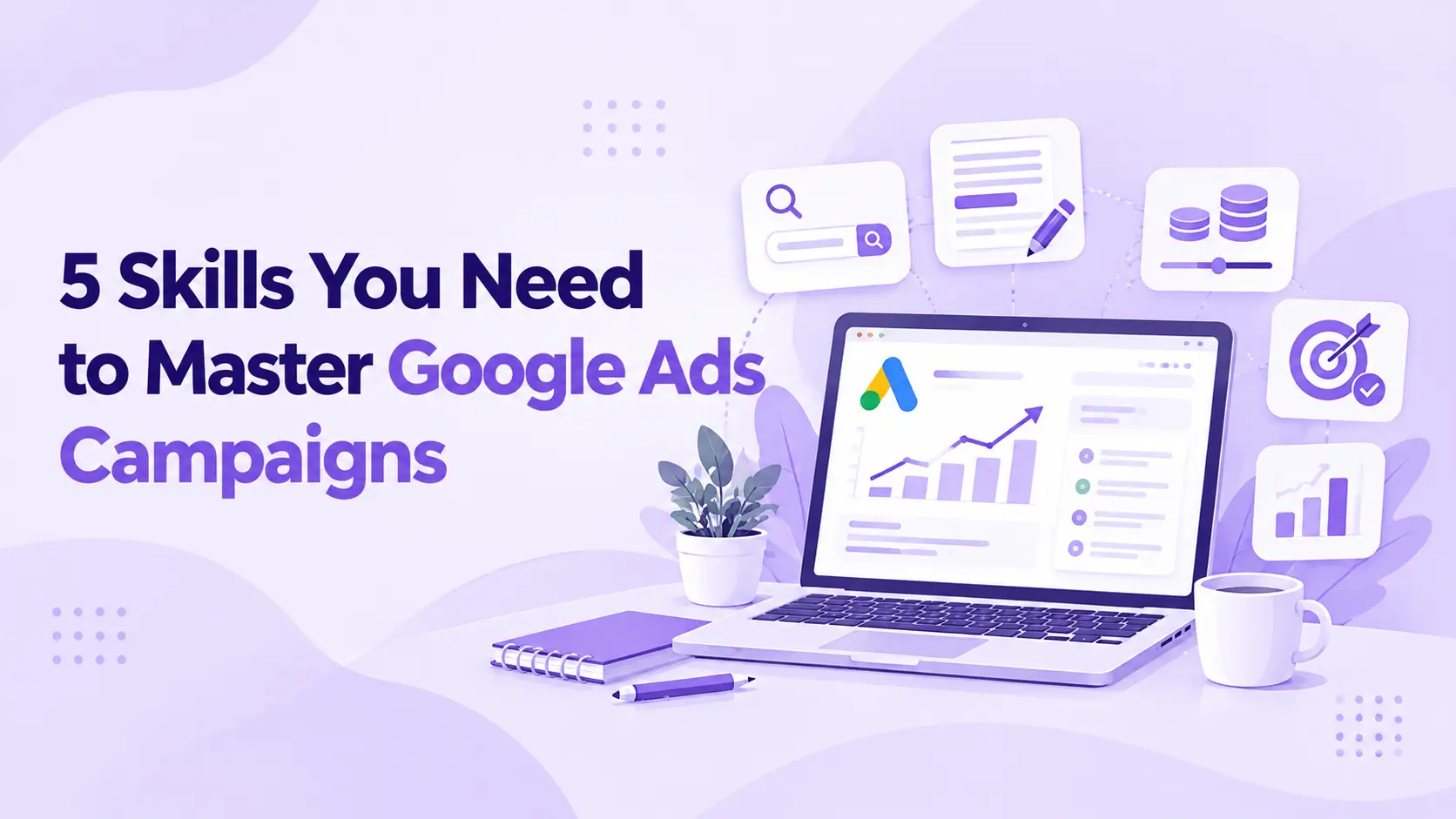
The five essential Google Ads skills are keyword research, ad copywriting, campaign strategy and bidding, conversion tracking, and campaign analysis and optimization. Together, these skills help marketers plan, measure, and improve paid search campaigns.
Why Are Google Ads Skills Valuable for a Career in Digital Marketing?
Google Ads skills are valuable because businesses need marketers who can connect advertising spend with measurable actions such as leads, sales, calls, or purchases. These skills also overlap with broader performance marketing abilities, including analytics, landing pages, targeting, and conversion optimization.
For digital marketing beginners, learning the platform is only one part of becoming job-ready. A strong beginner should be able to explain why a keyword was selected, how an ad matches search intent, what a campaign is trying to achieve, and which metrics show whether it is working.
What Skills Do You Need to Master Google Ads Campaigns?
To master Google Ads campaigns, you need five connected skills: keyword research and search intent, ad copywriting, campaign strategy and bidding, conversion tracking, and performance optimization. These skills help you make informed decisions instead of simply following platform settings.
1. Keyword Research and Search Intent
Keyword research helps you understand what potential customers are searching for and which searches are relevant to a business. Google Keyword Planner can generate keyword ideas, provide search estimates, and help with campaign planning.
Effective Google Ads keyword research goes beyond collecting high-volume terms. You also need to understand the intent behind each search.
For example, someone searching for “digital marketing course fees” has a different intent from someone searching for “what is digital marketing.” The first query may indicate stronger commercial interest.
A useful keyword research process includes:
- Finding relevant keyword ideas
- Grouping closely related terms
- Understanding search intent
- Reviewing competition and estimated costs
- Identifying negative keywords that can prevent irrelevant traffic
This skill matters because poor keyword choices can send paid traffic to people who were never likely to become customers.
2. Ad Copywriting and Message Matching
Ad copywriting is the skill of turning search intent into a clear reason to click. A good Google Ads marketer does not simply describe a product. The ad should address what the searcher wants and connect naturally with the landing page.
Suppose someone searches for “online digital marketing course for beginners.” An ad focused on advanced enterprise marketing may be less relevant than one that clearly speaks to beginners.
Strong ad copy should communicate:
- What is being offered
- Why it is relevant
- A useful benefit or differentiator
- A clear next step
Message matching matters across the journey. The keyword, ad, and landing page should make sense together. Google also recommends writing ads that directly relate to what customers want to buy.
3. Campaign Strategy, Budgeting, and Bidding
Campaign strategy means deciding what the campaign needs to accomplish before choosing its settings. The objective might be lead generation, sales, or another measurable business outcome.
Budgeting and bidding then determine how the campaign competes for available opportunities. Students should understand concepts such as CPC, CPA, conversion value, and ROAS rather than memorizing bidding options without understanding their purpose.
Google Ads supports automated bidding and Smart Bidding, which uses signals to set bids at auction time based on conversion or conversion-value goals. Conversion tracking is therefore closely connected to bidding decisions.
A beginner should be able to answer three questions:
- What is the campaign trying to achieve?
- How much can the business reasonably spend?
- Which bidding approach supports that objective?
4. Conversion Tracking and Analytics
Conversion tracking tells you whether ad interactions lead to actions that matter to the business. Depending on the campaign, those actions can include purchases, form submissions, calls, sign-ups, or app actions.
This is one of the most important Google Ads campaign skills because clicks alone do not tell you whether advertising is producing business value.
Students should become comfortable with metrics such as:
- Clicks and impressions
- Click-through rate
- Conversions and conversion rate
- Cost per conversion
- Conversion value
- ROAS
It is also useful to understand how Google Ads data can work alongside analytics tools such as Google Analytics 4. The goal is not to memorize every report. It is to know which measurement answers a particular business question.
5. Campaign Analysis and Optimization
Campaign optimization is the ability to look at performance data, identify a problem or opportunity, and decide what to change. It turns campaign management into an ongoing process rather than a one-time setup.
For example, a campaign may receive clicks but very few conversions. The answer is not automatically to increase the budget. You may need to investigate search terms, keyword relevance, ad messaging, landing page experience, targeting, or conversion tracking.
Google recommends using campaign performance data to evaluate metrics such as conversion rate, conversion value, ROAS, and bid strategy performance.
A practical optimization routine can include:
- Review performance against the campaign goal.
- Identify significant changes or weak areas.
- Check search terms, keywords, ads, and conversion data.
- Form a specific hypothesis about what needs improvement.
- Make a controlled change and monitor the result.
The key skill is learning to make decisions from evidence rather than changing several settings at once.
How Can Students Build Google Ads Skills?
Students can build Google Ads skills by combining structured learning with practical projects, measurement, analysis, and feedback. The goal should be to create evidence that you can apply what you have learned.
1. Take a Practical Digital Marketing Course: Learn Google Ads alongside SEO, analytics, content, social media, and other parts of a digital marketing workflow. A practical digital marketing course should give you opportunities to apply concepts rather than only study definitions.
2. Practice With Campaign Scenarios: Create sample campaigns for different goals, audiences, locations, and budgets. Practice choosing keywords, writing ads, and explaining your decisions.
3. Learn Google Ads and Analytics Tools: Build familiarity with Google Ads, Keyword Planner, Google Analytics 4, and conversion measurement.
4. Work on Projects and Build a Portfolio: Document a campaign plan, keyword research, sample ads, measurement setup, and optimization recommendations. A project can demonstrate your thinking even when you do not have paid client experience.
5. Apply Your Skills Through Internships: Real campaign environments teach you how budgets, deadlines, business goals, and performance data affect decisions. Internships can also show you how experienced marketers interpret results and prioritize changes.
Google Ads Skills vs Google Ads Certification: What’s More Important?
Practical Google Ads skills are more useful for demonstrating job readiness, while certification can provide a structured way to validate platform knowledge. The two work best together.
At Cvilians, experts offer digital marketing courses designed to demonstrate knowledge of creating, measuring, and optimizing campaigns. Certification can strengthen a beginner’s profile, but it does not replace the ability to analyze a campaign, explain decisions, and solve performance problems.
For students, the strongest combination is certification + practical projects + a clear understanding of campaign performance.
Conclusion
Mastering Google Ads campaigns requires more than learning where to click inside the platform. The most valuable skills are keyword research, ad copywriting, campaign strategy, measurement, and optimization.
Students who practice these skills through realistic projects can build a stronger foundation for PPC and performance marketing roles. The aim should not be to memorize every Google Ads feature. It should be to understand the reasoning behind each campaign decision and learn how to improve performance using evidence.