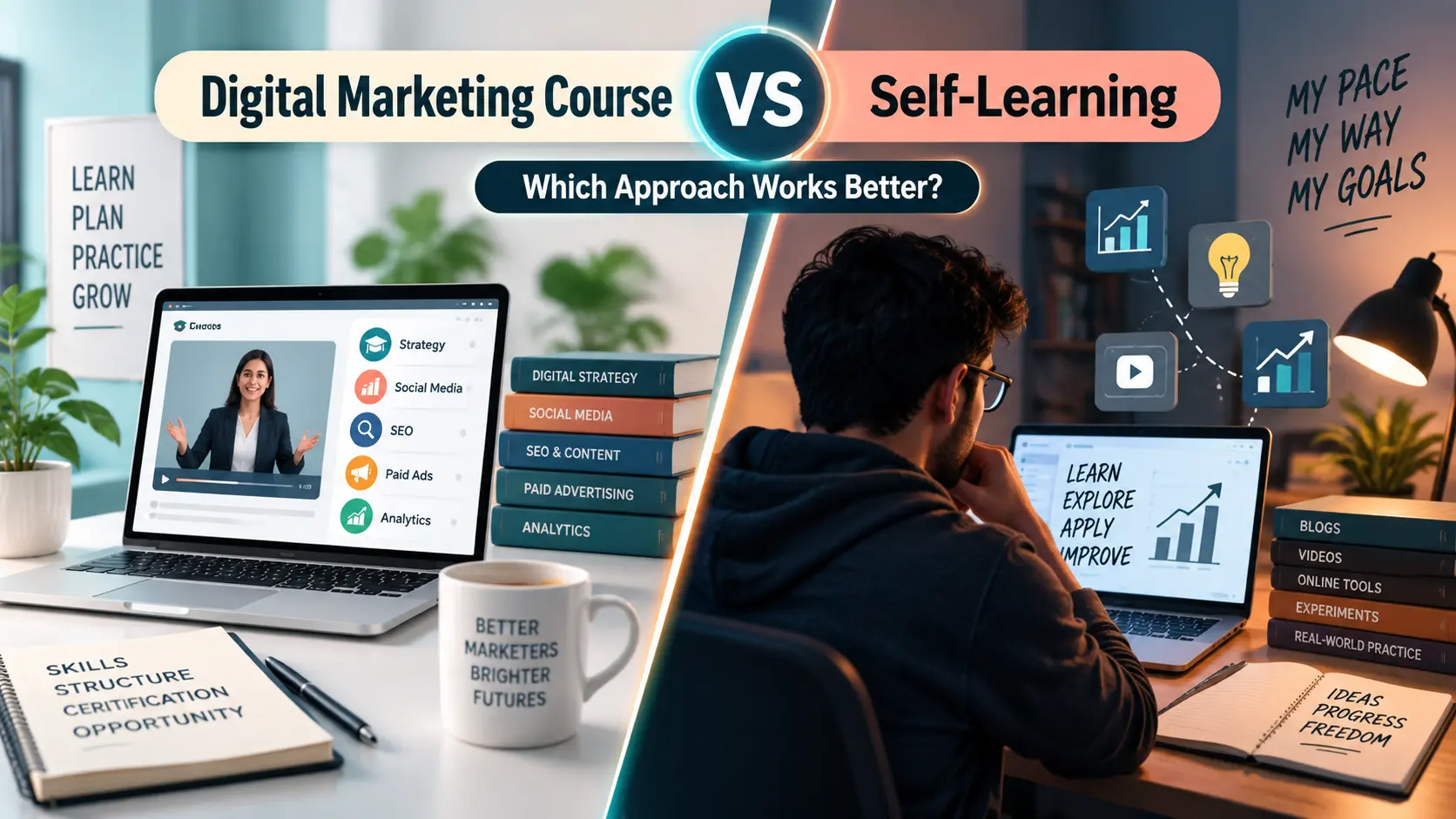
Digital Marketing Course vs Self-Learning: Which Approach Works Better?
Quick Answer: A digital marketing course can be better for beginners who need structure, practical training, and expert guidance. Self-learning can work well for disciplined learners who prefer flexibility and independent research. For many learners, combining both approaches offers the strongest path.
What Does a Digital Marketing Course Teach?
A good digital marketing course should teach more than definitions and marketing theories. It should help you understand how different digital channels work and, more importantly, how to apply that knowledge.
Depending on the course, you may learn:
- Search engine optimization (SEO): Keyword research, on-page optimization, technical SEO, link building, and performance analysis.
- Content marketing: Content planning, search-focused writing, content optimization, and distribution.
- Social media marketing: Platform strategy, content planning, audience research, and performance measurement.
- Paid advertising: The basics of search and social advertising, campaign structure, targeting, and optimization.
- Email marketing: List building, campaign planning, segmentation, and performance tracking.
- Analytics: Understanding traffic, conversions, engagement, and other important marketing metrics.
- Practical campaign work: Applying concepts through projects, website work, campaign exercises, or real-world examples.
The biggest difference between a strong course and a collection of online tutorials is structure. Instead of deciding what to learn next, you follow a defined path from fundamentals to practical application.
Benefits of Taking a Digital Marketing Course
A structured course can make the learning process easier, especially when you are starting from scratch.
- You Get a Clear Learning Path
Digital marketing covers many areas. Without a roadmap, beginners can jump from SEO to social media to Google Ads without understanding how these skills connect.
A course organizes topics in a logical sequence, making it easier to build your knowledge step by step.
- You Learn Through Practical Work
Knowing what SEO means is different from actually auditing a website. Understanding paid advertising is different from creating and optimizing a campaign.
Practical assignments help bridge that gap between knowing something and being able to do it.
- You Can Get Expert Guidance
When learning alone, you may spend hours trying to understand why something isn’t working. With instructor support or mentorship, you can often identify mistakes faster and understand why a particular approach works.
- You Have More Accountability
Self-learning requires discipline. It is easy to watch a few videos, save several articles, and then stop practicing.
A structured course gives you milestones, assignments, and deadlines that can help you stay consistent.
- You Can Build Job-Relevant Skills
A good course should help you move beyond theory and develop skills you can demonstrate through projects, campaign work, audits, reports, or other practical outputs.
That experience can be more useful than simply completing lessons.
Can Someone Learn Digital Marketing on Their Own?
Yes, you do not need to enroll in a digital marketing course to learn the fundamentals or develop useful marketing skills.
There are countless resources available through search engines, industry websites, video platforms, documentation, communities, and free educational resources.
For example, someone interested in SEO could start by learning:
- How search engines discover and index pages
- Keyword research and search intent
- On-page SEO
- Technical SEO fundamentals
- Internal linking
- Content optimization
- Link building
- SEO measurement and reporting
They can then apply these concepts to their own website or a practice project. However, in a digital marketing course, you are guided by experienced professionals and get opportunities to work on real campaigns, helping you avoid common mistakes and learn more efficiently.
Benefits of Learning Digital Marketing on Your Own
Self-learning has some clear advantages, particularly for people who already have basic knowledge or prefer independent study.
- Lower Cost
You can learn many digital marketing fundamentals using free resources. This makes self-learning attractive if your budget is limited.
- Complete Flexibility
You decide when, where, and what to study. This can work particularly well for students, professionals, freelancers, or business owners with changing schedules.
- Learn at Your Own Pace
You can spend more time on difficult subjects and move quickly through concepts you already understand.
- You Can Follow Your Interests
Someone interested mainly in SEO does not necessarily need to spend equal time learning every digital marketing channel.
Self-learning allows you to specialize based on your goals.
- It Develops Independent Research Skills
Digital marketing changes frequently. Search algorithms, advertising platforms, analytics tools, and AI technologies continue to evolve.
Learning how to find reliable information and evaluate new strategies is therefore a valuable skill in itself.
What Are the Challenges of Self-Learning Digital Marketing?
Self-learning gives you freedom, but that freedom can also become a problem.
The most common challenges include:
- No clear roadmap: You may not know which topics to learn first.
- Information overload: Thousands of resources can make it difficult to decide what actually matters.
- Conflicting advice: Different creators may recommend completely different approaches.
- Limited feedback: You may not know whether your work is correct or how it could improve.
- Theory without practice: Consuming content does not automatically create practical skills.
- Consistency problems: Without deadlines or accountability, learning can easily become irregular.
- Outdated information: Some tutorials remain online long after tools, platforms, or best practices have changed.
For example, watching ten videos about keyword research does not necessarily teach you how to build a keyword strategy for an actual website. Application is what turns information into skill.
What Should You Look for in a Digital Marketing Course?
Not every digital marketing course offers the same value. Before enrolling, look beyond the course title and check what you will actually do during the program.
Look for:
| What to Check | Why It Matters |
| Practical projects | Helps turn concepts into usable skills |
| Updated curriculum | Digital marketing changes regularly |
| Experienced instructors | Provides practical context and guidance |
| Feedback or mentorship | Helps identify and correct mistakes |
| Real-world examples | Shows how strategies work beyond theory |
| Portfolio opportunities | Gives you work you can demonstrate |
| Multiple marketing channels | Helps you understand the wider digital ecosystem |
A strong digital marketing course should help you learn, practice, analyze, improve, and apply.
Digital Marketing Course vs Self-Learning: Which One Should You Choose?
There is no single answer for everyone.
| If You… | Consider |
|---|---|
| Are completely new to digital marketing | Digital marketing course |
| Need a clear learning roadmap | Digital marketing course |
| Want practical projects and feedback | Digital marketing course |
| Have a limited budget | Self-learning |
| Prefer complete flexibility | Self-learning |
| Already understand the fundamentals | Self-learning or Specialised Training |
| Want structure but also enjoy independent research | A combination of both |
For beginners, a digital marketing course can reduce the uncertainty that comes with starting from zero. You have a defined curriculum and can learn through a planned sequence rather than piecing information together yourself.
Self-learning can be more effective when you already know the fundamentals and want to deepen a specific skill, explore a new tool, or keep up with industry changes.
In many cases, however, the strongest approach is combining both. That combination helps you develop both guided knowledge and independent learning.
Conclusion
The choice between a digital marketing course and self-learning depends on your goals, learning style, budget, and experience.
Self-learning can provide flexibility and access to a huge amount of information. A good digital marketing course can provide something harder to create alone: structure, practical experience, guidance, feedback, and accountability.
For beginners, structured learning can make the journey more focused, while experienced learners may benefit from combining a digital marketing course with continuous self-learning. This practical approach is also what CVilians emphasizes through hands-on learning and real campaign experience.
Ultimately, the best approach is the one that helps you turn what you learn into skills you can actually apply.