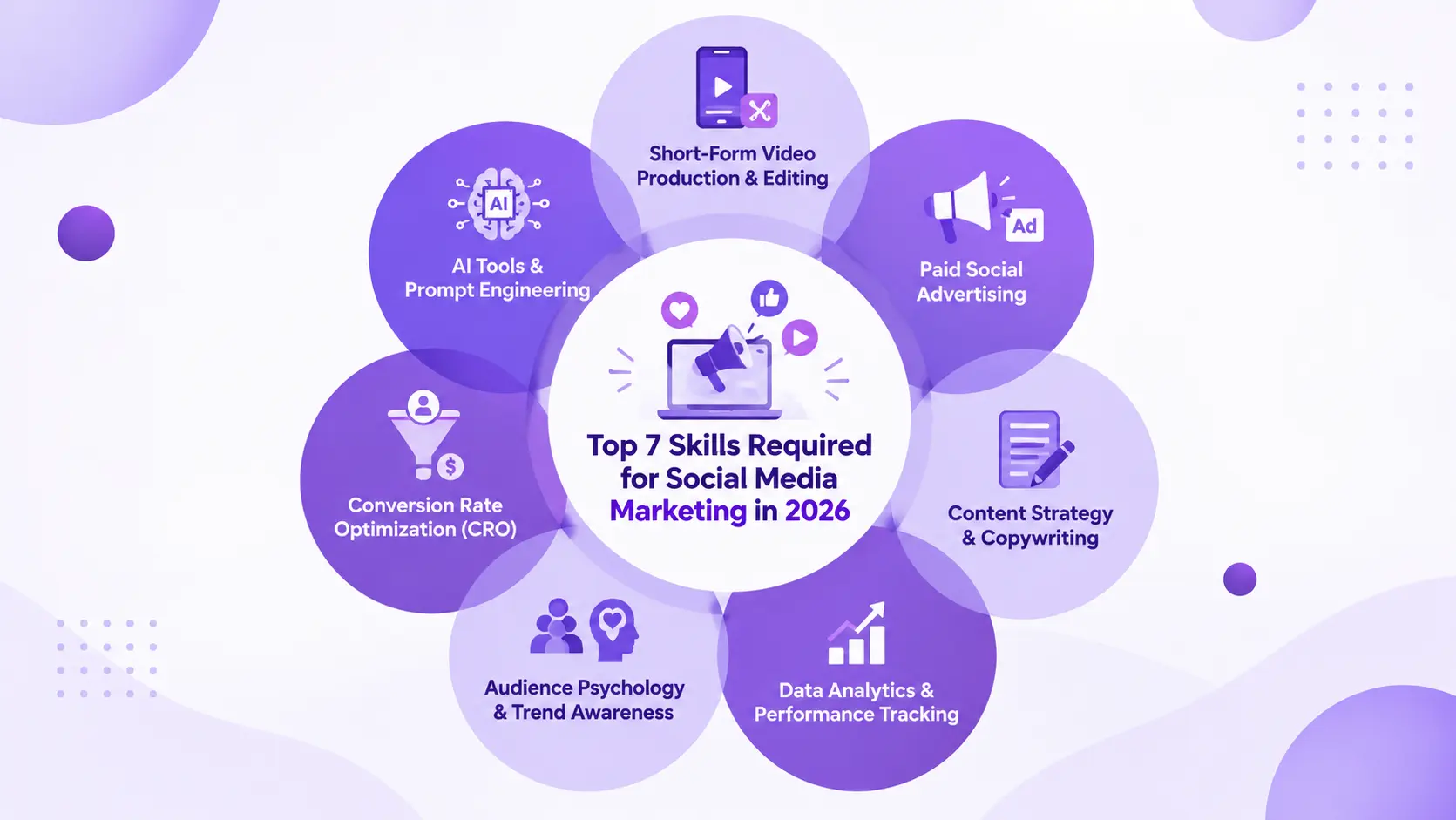
Top 7 Skills Required for Social Media Marketing in 2026
The top skills required for social media marketing in 2026 include short-form video production, AI and prompt engineering, paid social advertising, content strategy and copywriting, data analytics, audience psychology, trend awareness, and conversion optimization. Strong marketers combine creative, technical, analytical, and strategic skills.
Is Social Media Marketing a Good Career in 2026?
Yes, social media marketing remains a strong career option in 2026 because businesses continue using social platforms to build awareness, engage audiences, generate leads, and support sales.
The role is also becoming more skill-based. LinkedIn’s 2026 Skills on the Rise research says employers are increasingly prioritizing what people can do rather than relying only on degrees or job titles.
A social media marketer today is not simply responsible for publishing posts. The job can involve video, paid campaigns, copywriting, analytics, audience research, AI tools, and conversion-focused thinking.
What Skills Are Required for Social Media Marketing?
The most valuable social media marketing skills in 2026 combine creative production, technology, strategy, analytics, and customer understanding. The seven below cover the core abilities beginners can build for real-world social media work.
1. Short-Form Video Production and Editing
Why It Matters:
Short-form video is now a core content format across platforms such as Instagram, YouTube, and TikTok. HubSpot’s 2026 research identifies short-form video as one of the leading formats marketers are investing in.
Social media marketers do not necessarily need professional filmmaking skills. They need to understand hooks, pacing, framing, captions, transitions, and platform-specific formats.
How to Learn (Actionable Tips)
- Choose a brand and create three short video concepts around different audience problems.
- Practice editing with tools such as CapCut or Canva, focusing on hooks, captions, pacing, and clean cuts.
- Compare videos using watch time, retention, shares, and saves when real performance data is available.
2. AI Tools and Prompt Engineering
Why It Matters:
AI is now part of everyday marketing workflows. HubSpot reports that 80% of marketers use AI for content creation and 75% use it for media production in 2026.
The valuable skill is not simply knowing how to write prompts. It is knowing how to use social media tools and AI for research, ideation, content variations, repurposing, and workflow support while applying human judgment to the final output.
How to Learn (Actionable Tips)
- Practice prompts for audience research, content ideas, hooks, captions, and content repurposing.
- Build a workflow where AI creates options, and you fact-check, edit, and adapt them to a brand voice.
- Test different prompts and compare outputs instead of accepting the first response.
3. Paid Social Advertising
Why It Matters:
Organic reach is only one part of social media marketing. Paid social allows marketers to reach defined audiences, test creative, generate leads, and support conversions.
Beginners should understand campaign objectives, audience targeting, creative testing, budgets, tracking, and basic performance metrics. The goal is not to memorize every advertising setting, but to understand why a campaign is structured in a particular way.
How to Learn (Actionable Tips)
- Build a mock campaign and define its objective, audience, offer, and creative.
- Learn how Meta Ads Manager structures campaigns, ad sets, ads, audiences, and reporting.
- Practice interpreting CTR, CPC, conversion rate, and cost per result.
4. Content Strategy and Copywriting
Why It Matters:
Good social media content needs a reason to exist. Content strategy determines what a brand should communicate, while copywriting shapes how that message is presented.
A social media marketer should know how to create content pillars, write hooks, develop captions, use calls to action, and adapt messaging to different platforms.
How to Learn (Actionable Tips)
- Create three to five content pillars for a chosen brand and connect each to a business goal.
- Write multiple hooks and captions for the same idea and identify the clearest version.
- Adapt one topic for Instagram, LinkedIn, and short-form video instead of copying the same post.
5. Data Analytics and Performance Tracking
Why It Matters:
Analytics turns social media activity into useful marketing decisions. Without performance tracking, a marketer cannot reliably tell which content deserves more investment.
Learn to interpret reach, impressions, engagement, clicks, conversions, and cost-related metrics. More importantly, connect those numbers to decisions. If a format attracts views but produces little meaningful action, the strategy may need to change.
How to Learn (Actionable Tips)
- Create a simple weekly social media report with key metrics and observations.
- Compare content by format, topic, hook, and call to action instead of looking only at follower growth.
- Turn each report into one clear action, such as testing a new hook or reducing investment in weak creative.
6. Audience Psychology and Trend Awareness
Why It Matters:
Social media marketing works better when you understand why people stop, watch, share, comment, click, or buy. Audience psychology helps marketers identify motivations, objections, emotions, and information needs.
Trend awareness matters too, but following every viral format is not a strategy. A skilled marketer evaluates whether a trend fits the audience, brand, platform, and campaign objective.
How to Learn (Actionable Tips)
- Study comments, reviews, competitor posts, and customer questions to identify recurring audience problems.
- Keep a trend tracker with formats, topics, creators, and examples relevant to your niche.
- For every trend, ask whether it supports the brand message before using it.
7. Conversion Rate Optimization (CRO)
Why It Matters:
Social media performance should not stop at likes or views. Conversion rate optimization focuses on what happens after someone clicks, including landing pages, forms, product pages, signups, and other conversion points.
This skill helps social media marketers connect content and advertising with business outcomes. It also encourages an important question: if people are clicking, what might be preventing them from taking the next step?
How to Learn (Actionable Tips)
- Review a landing page and identify friction in the headline, offer, form, CTA, or page structure.
- Create two versions of a CTA or landing-page message and define the metric that would determine the winner.
- Learn how social traffic moves from a post or ad to a landing page and then to a conversion.
How to Turn These Skills Into Real-World Experience
The best way to build social media marketing skills is to use them together on real campaigns and projects. Learning each skill separately can give you knowledge, but practical work shows you how those skills connect.
For example, a beginner could take a digital marketing course that uses real-world projects. This helps you learn these skills with practical examples.
It will teach students how to:
- Research the audience: Identify customer needs, interests, and content preferences.
- Build the strategy: Choose content pillars, platforms, formats, and campaign goals.
- Create the content: Write captions, develop short-form videos, and design supporting creatives.
- Test promotion: Build a sample paid social campaign and define the target audience.
- Measure performance: Track engagement, clicks, conversions, and other relevant metrics.
- Improve the campaign: Identify what worked, what did not, and what should change.
- Document the work: Turn the process and results into a portfolio project.
Instead of treating social media, advertising, analytics, and content as completely separate topics, learners can see how each skill contributes to a broader digital marketing campaign.
That experience can also give beginners something concrete to discuss during interviews, rather than simply saying they have completed a social media marketing course.
Conclusion
The best social media marketing skills in 2026 go beyond posting consistently. Marketers need to create strong content, use AI responsibly, understand paid campaigns, read performance data, recognize audience behavior, and connect social activity with conversions.
For beginners, the priority should be practice. Build campaigns, test ideas, measure results, and document what you learn. A portfolio showing how you think and execute can be more useful than simply listing the tools you have used.